A defective pipe, leaks, or root intrusion are serious problems that endanger the substance of your building. In the past, pipe rehabilitation often involved a large, messy construction site, but those times are over.
Every successful rehabilitation begins with a precise sewer inspection. Only after a detailed analysis, often using a CCTV sewer inspection, do we plan the best procedure for you. As technological pioneers, we specialize in trenchless CIPP sewer lining. For you, this means: no excavator in the garden, no destructive cutting work, no annoying noise, and no mess.
With this modern process, we efficiently rehabilitate your pipes from the inside. The result is a durable and tight pipeline that provides you with security for decades.
Frequently asked questions about pipe & sewer rehabilitation
Here you will find answers to the most frequently asked questions about pipe rehabilitation and sewer rehabilitation.
CIPP lining is a modern, trenchless method of repairing defective pipes from the inside. A flexible fabric hose impregnated with resin (the “liner”) is inserted into the old pipe and cured there. This creates a completely new, structurally self-supporting pipe that bonds firmly with the old pipe – without having to dig up your garden or paths. The goal is so-called full-length rehabilitation of sections of up to 100 meters in one go, extending the overall service life of the sewer in the long term.
How does CIPP lining work?
Every rehabilitation starts with a precise CCTV sewer inspection to analyze the damage exactly. Based on this, the old pipe is thoroughly cleaned in preparation. We then insert the resin-impregnated liner, which cures with heat or UV light to form a new, watertight pipe inside the old one. A final camera inspection documents the high quality and success of the rehabilitation for you.
What are the main benefits of CIPP lining?
The biggest advantage is that no excavation work is required. Your property remains untouched, which saves you considerable time, costs, noise and dirt. In addition, the new pipe in the pipe is extremely durable and resistant to cracks and root growth. You get a sustainable solution with minimal impact.
How long does CIPP lining last?
Professionally installed CIPP lining is an extremely long-lasting solution. Depending on the system and load, the technical service life of the newly rehabilitated pipe is up to 50 years. You are therefore investing in a long-term, sustainable solution that gives you security and peace of mind for decades.
What is the difference between a spot repair and CIPP lining?
A spot repair (short liner) is a solution for individual, local damage such as cracks or leaking joints. It is often also an important preparatory step for CIPP lining. With CIPP lining (also known as long liner or full-length rehabilitation), on the other hand, we rehabilitate entire pipe sections of up to 100 meters in one go. This creates a completely “new pipe” bonded to the old pipe, extending the overall service life of the sewer in the long term.
How much does sewer rehabilitation with CIPP lining cost?
The costs of CIPP lining depend on several factors, such as the length, diameter and exact condition of the old pipe. As a non-binding guide, the costs usually range from €150 to €450 per linear meter.
Our principle is complete transparency: a professional CCTV sewer inspection is always the basis for an accurate calculation. Based on this analysis, you will receive a clear and detailed quote from us with no hidden costs, so you know exactly what to expect from the outset.
Will my insurance cover the costs of sewer rehabilitation?
In many cases, yes, especially if there is acute damage covered by buildings insurance (as part of tap water coverage). However, the details of your personal policy are always decisive, which is why we recommend that you check with your insurance company beforehand. We will of course provide you with a transparent and detailed invoice for your submission.
Our pipe and sewer rehabilitation methods in detail
Depending on the type of damage, the condition of the pipe and cost-effectiveness, we select the technically best and most suitable method for you. Our focus is always on trenchless, minimally invasive techniques. The aim is to minimize effort and costs for you while keeping the impact of noise, dirt and CO2 emissions on residents and the environment as low as possible.
CIPP lining
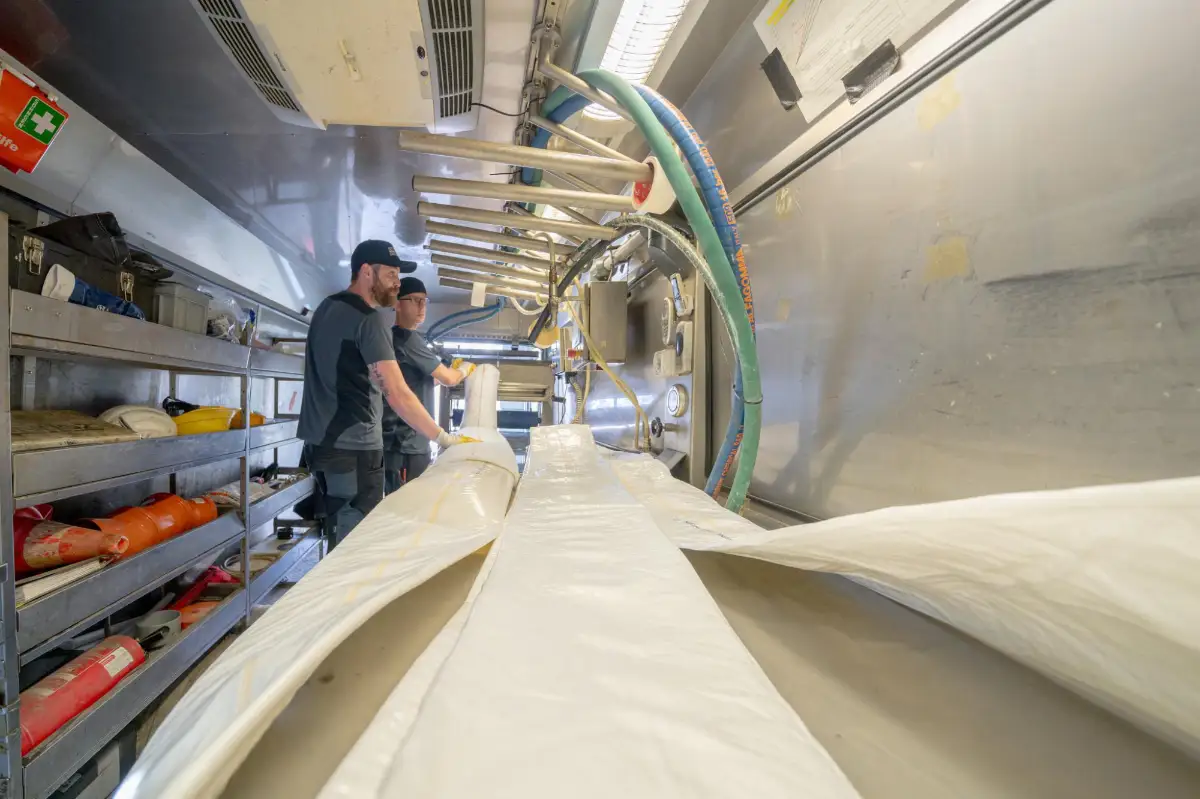
CIPP (cured-in-place pipe) lining is a trenchless method that creates a new, structurally self-supporting pipe inside the old one. A flexible needle-felt or glass-fiber liner is inserted into the pipe, impregnated with two-component epoxy resin during the process and then cured. Any lateral connections are then precisely reopened with a remote-controlled robotic cutter.
Preparing the liners
Key features at a glance:
Application: Rehabilitation of longer, continuous pipe sections.
Key advantage: A completely new, watertight and durable inner pipe wall without excavation.
Technical details: Suitable for pipe diameters from 50 to 400 mm; several changes in diameter possible; laterals are reopened by milling after lining; new wall thickness up to 16 mm.
Spot repair (inner sleeve & top hat repair)
Spot repair is a fast and cost-effective method for repairing individual cracks, holes or leaks in pipes, sewers and lateral connections. Our experts install inner sleeves or top hat sections from the inside that are precisely adapted to the pipe and the type of damage. Since the process is completely trenchless, the surface remains untouched. This targeted repair is often also the ideal preparation for subsequently lining entire underground drains or downpipes.
Key features at a glance:
Application: Targeted repair of individual cracks, holes and leaks in pipes, sewers and lateral connections.
Key advantage: Extremely fast and cost-effective, as only the actual damage is repaired.
Technical details: Trenchless repair using inner sleeves and top hat repairs.
Horizontal drilling
Horizontal drilling is the most economical method for installing new pipes without trenches, especially when the old pipe can no longer be rehabilitated. A special drilling rig “shoots” a new pipe route underground without having to open up large areas of gardens, paths or asphalt. Only a small launch pit and a small reception pit are required.
Key features at a glance:
Application: Trenchless installation of new pipes when rehabilitation is technically impossible or uneconomical.
Key advantage: The most economical way to install new pipes, with only minimal surface intervention.
Technical details: Suitable for new pipes with a diameter of up to 500 mm.
Manhole rehabilitation
Manhole rehabilitation restores the watertightness and stability of sewer manholes using professional concrete and masonry repair methods. Over the years, manholes often suffer from biogenic sulfuric acid and environmental influences such as frost and ground movement. In severe cases where rehabilitation is no longer sufficient, the manhole has to be completely rebuilt.
Key features at a glance:
Application: Repair of manholes damaged by environmental influences, corrosion or cracks.
Key advantage: Fast restoration of the manhole’s full functionality and watertightness.
Technical details: Professional concrete and masonry repair methods; excavation is only required if the manhole is rebuilt.
Open-cut method (excavation)
The open-cut method is the rehabilitation method we use when trenchless processes are not technically possible. Here, too, you benefit from our full service: our experts carry out all the necessary construction work professionally and in a coordinated manner – from excavation to perfect surface restoration.
Key features at a glance:
Application: Repair or replacement if trenchless rehabilitation is not possible (e.g. in the event of a collapse or a severe reverse gradient).
Key advantage: You get all sewer and construction work from a single source and have just one contact person for the entire project.
Technical details: Includes all earthworks and excavation, pipe replacement and complete restoration of surfaces.
Service Area for Pipe Cleaning, Sewer Rehabilitation & Sewer Technology
We offer our full range of services to private households, property management companies, and commercial businesses throughout Vienna, Lower Austria, and Burgenland. For larger jobs and planned projects, we also operate on a supra-regional basis.
Pipe Cleaning & Drain Clearing in Vienna
We provide fast and reliable pipe clearing services across all 23 districts of Vienna. DerKanal is your specialist for professional pipe and sewer cleaning as well as rapid drain clearing – whether in Donaustadt, Favoriten, or Floridsdorf. From our main office in 1230 Vienna-Liesing, we coordinate every job directly across the entire city area.
Sewer technology in Vienna, Lower Austria & Burgenland
Our entire service portfolio is available to you without restriction throughout Vienna, Lower Austria, and Burgenland. DerKanal is your reliable specialist for professional drain cleaning, trenchless sewer rehabilitation, separator cleaning, and leak testing. Whether in St. Pölten, Wiener Neustadt, Baden, Mödling, Klosterneuburg, Eisenstadt, Neusiedl am See, or Oberwart—we provide all services directly on-site.
Major projects & specialized work across Austria
For comprehensive and planned projects—such as liner rehabilitation, specialized milling work, and backflow protection—we extend our service radius to support you in Styria (e.g., Graz, Leoben, Kapfenberg), Upper Austria (e.g., Linz, Wels, Steyr), Carinthia (e.g., Klagenfurt, Villach, Wolfsberg), and Salzburg.