

During heavy rain, the water stopped draining off the flat roof – a first sign that something was wrong with the downpipes. The reason: massive corrosion in several downpipes of an office building from the 1970s. Find out here how we turned them back into watertight, stable downpipes without disrupting office operations.
Project Profile: Downpipe Relining
- Initial situation: After around 50 years, several downpipes made of mixed cast iron with stainless steel sections were so badly corroded that the water could no longer drain away.
- Project location: Maria Enzersdorf, Lower Austria
- Client: NVImmobilien
- On-site project team: Philipp (project manager), Gregor (quality management), Dariusz (site manager), Zygmunt (equipment operator), Jozef (skilled worker)
- Trigger: After a heavy downpour, rainwater no longer drained through the downpipes. The subsequent CCTV sewer inspection finally revealed the full extent of the corrosion.
- Affected area: A total of 10 rainwater downpipes in the building, all of the same age and equally affected, each around 25 meters long across 8 floors.
- Solution: Rehabilitation without chiseling open walls, using a hose liner (CIPP liner) that is inserted into the existing pipes from top to bottom and pressed against the pipe wall with compressed air.
- Benefit for ongoing operations: The offices in the building remained fully usable throughout the entire rehabilitation; no walls had to be opened up.
- Result: All 10 downpipes are fully watertight and free-flowing again; all branch connections were precisely reopened by milling and put back into service.
What Is Downpipe Relining, and When Is It Necessary?
Downpipe relining (also known as stack relining) repairs a building's vertical wastewater or rainwater pipe without replacing it completely. In most cases, a liner is inserted into the existing pipe from the inside, where it then cures.
Because a downpipe usually serves several floors and units at the same time, damage there rarely has only a local effect. That makes it all the more important to find a solution that is technically reliable and can be integrated into the building's ongoing operations. Typical signs that rehabilitation is necessary include:
- deposits that build up inside the pipe and reduce the flow
- cracks, leaks or material fatigue in older pipes
- corrosion in metal pipe systems (cast iron, steel) or signs of aging in plastic pipes
- unpleasant odors or hygiene problems in the building
- recurring blockages or noticeably reduced drainage capacity
Rainwater No Longer Drains Through the Downpipes After a Downpour
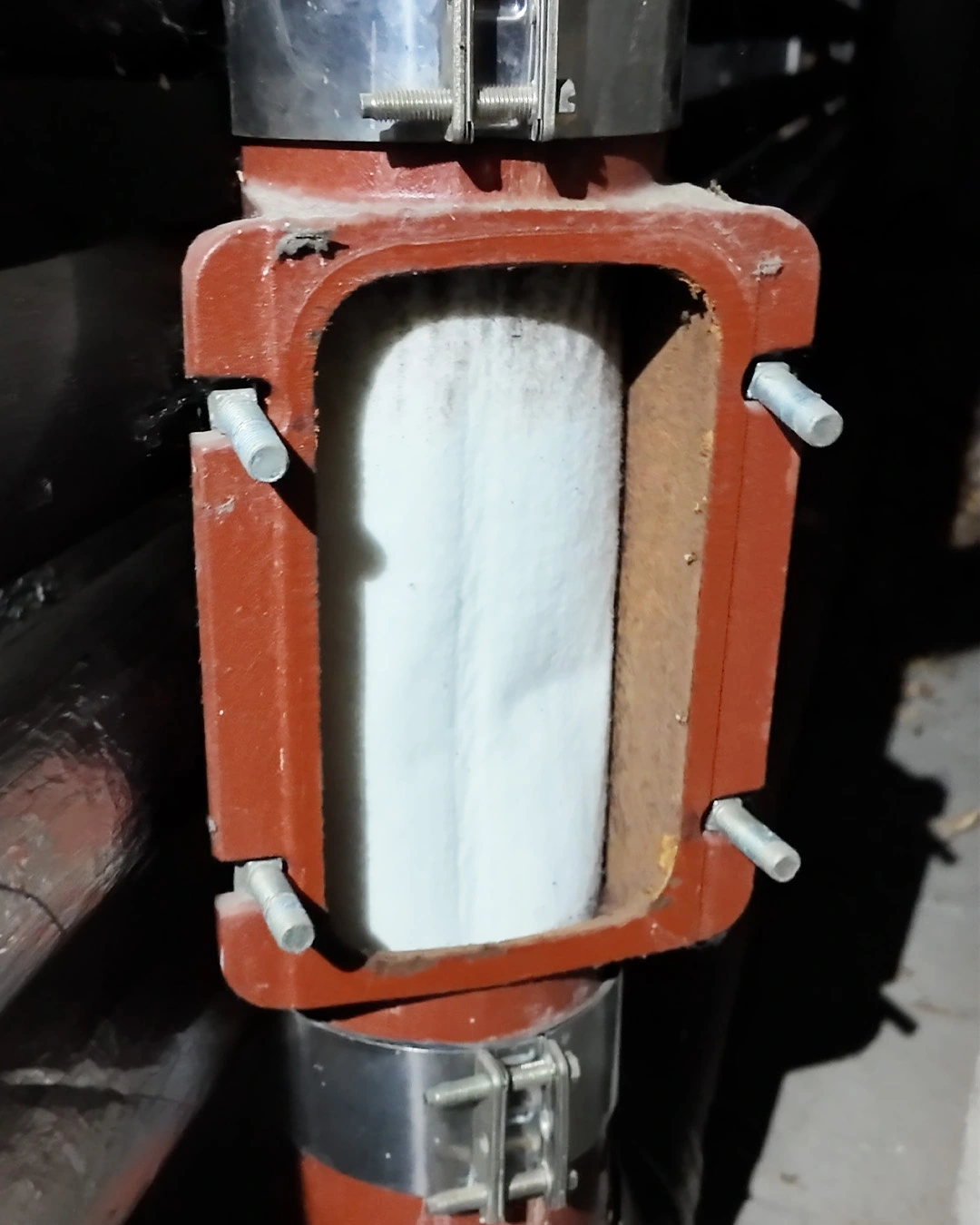
After a downpour, the rainwater from an office building no longer drained through the downpipes. To find the cause, our team carried out a CCTV sewer inspection even before cleaning. It revealed that the old downpipes, made of a mix of cast iron and stainless steel pipe, were heavily rusted and full of deposits. In several places, the corrosion had literally perforated the pipe wall, much like Swiss cheese.
The deposits were removed during a thorough cleaning so that the flow was fully restored. However, because the pipes were badly corroded and no longer watertight, CIPP relining was necessary. Since all ten rainwater downpipes in the building dated from the same construction period, it quickly became clear: urgent action was needed not just for one pipe, but for all of them.
What Are the Benefits of Relining Downpipes?
The biggest advantage: the downpipes can be rehabilitated without chiseling open walls, so office operations can continue undisturbed. This is made possible by downpipe relining using the CIPP lining process: the existing pipe route is preserved, and a new, resin-impregnated liner is pulled directly into the old pipe, where it cures to a perfect fit.
With a conventional pipe replacement, this would not have been possible. The downpipes would have had to be exposed, which would have meant opening up walls and cladding on several floors. In a fully leased office building in daily use, that is hardly practical: noise, dust and weeks of construction work in the middle of the tenants' working day are simply not an option.
The Downpipe Relining Process
1. Diagnosis by CCTV Inspection & Pipe Cleaning
Even before the downpipe was cleaned, our team inspected it with a sewer camera to find the cause of the blockage. This allowed us to precisely document the condition of the pipe wall, the position of the branch connections and the extent of the corrosion. A thorough cleaning followed immediately after the inspection so that the flow was fully restored.
2. Inserting the Liner into the Downpipes
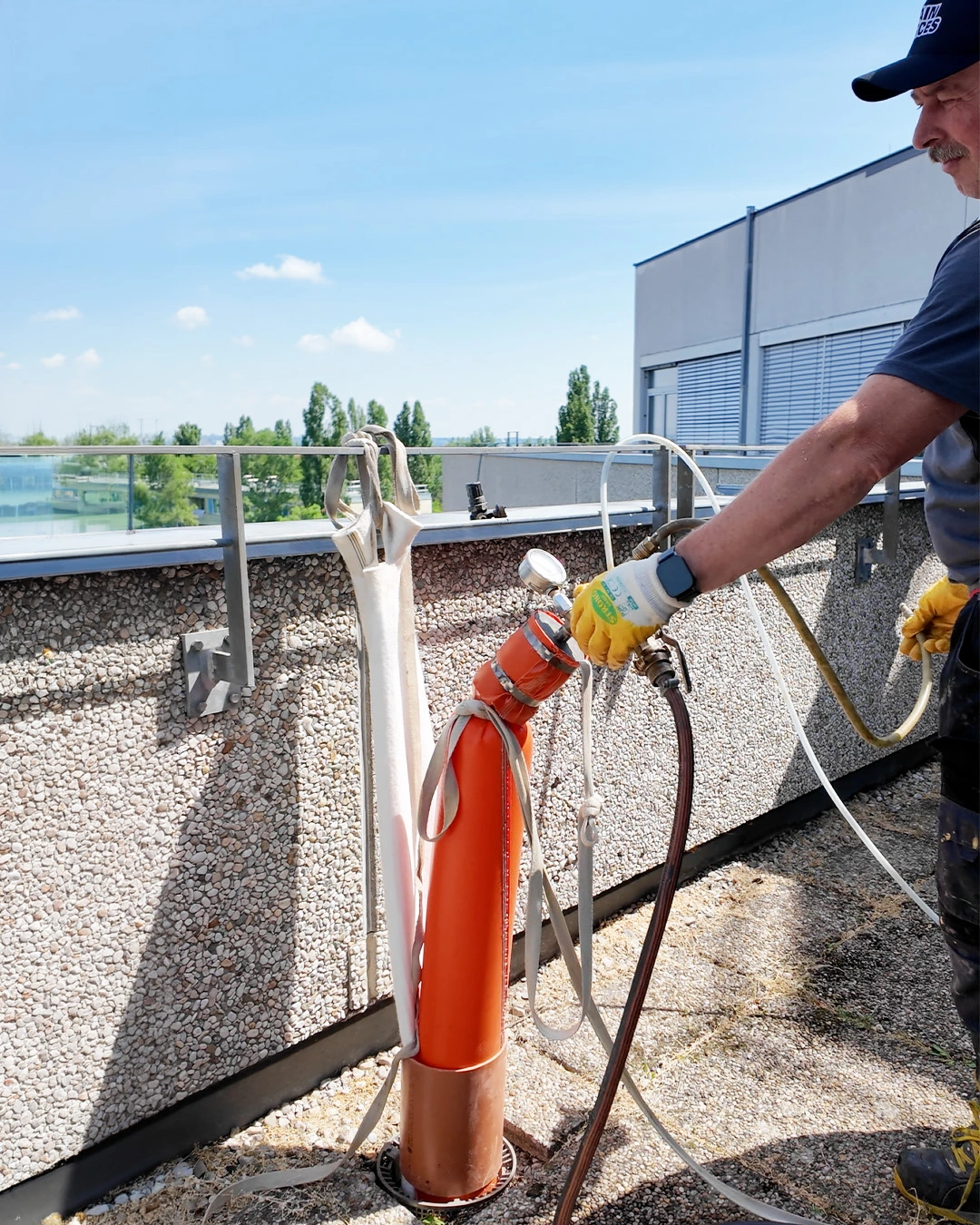
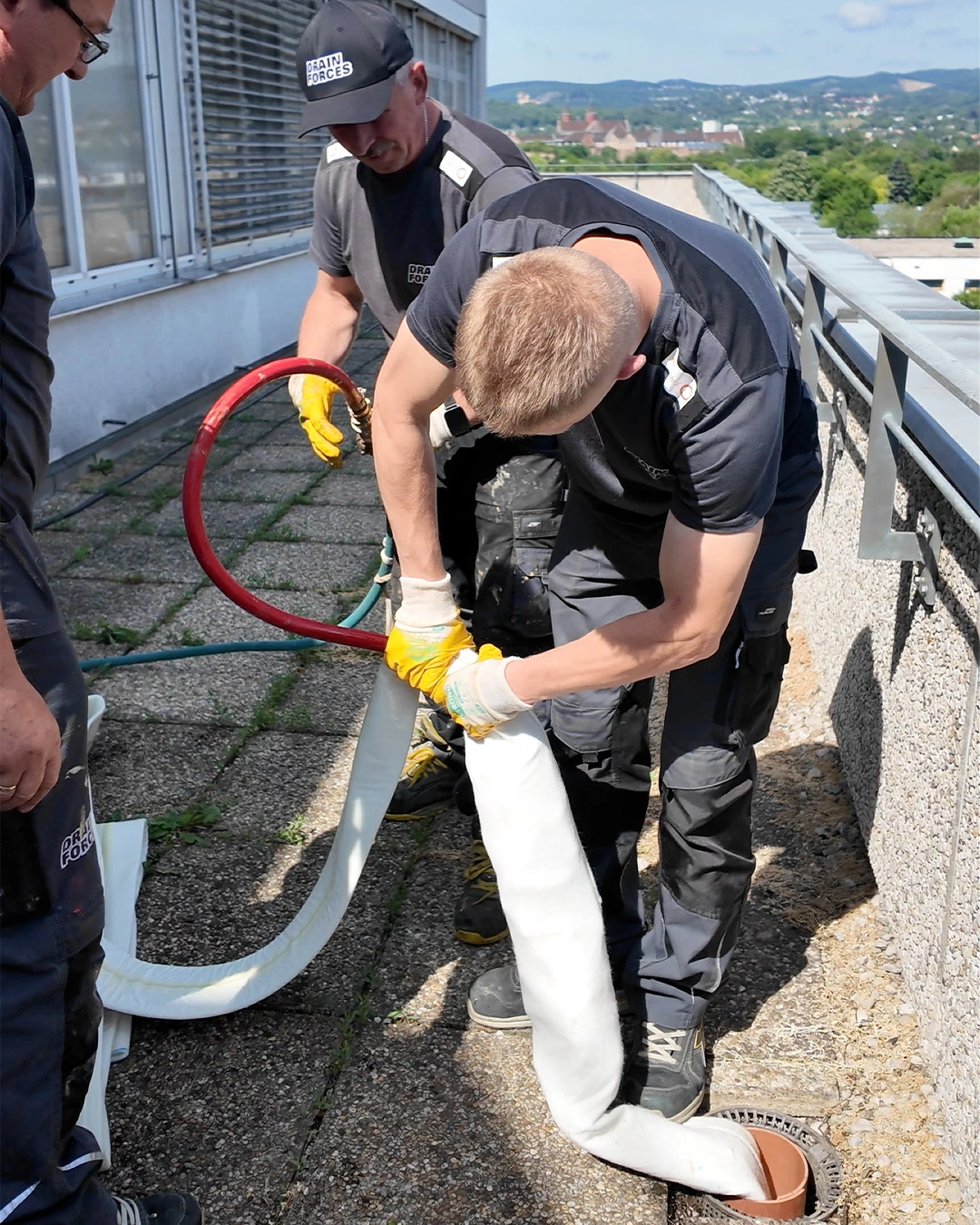
Because the downpipes had to be rehabilitated along their entire length of eight floors, the liner was pulled in as a single piece from top to bottom. Impregnated with resin and hardener, the liner was fed down into the pipe from the roof by hand, meter by meter, supported by compressed air from a compressor in the basement.
3. Calibrating and Pressing
Once it reaches the basement, the liner is cut to a precise fit. A so-called calibration hose then presses the material against the pipe wall at around 0.5 bar. At each branch connection, this automatically creates a small bulge in the liner, which marks the later opening to the branch lines.
4. Reopening the Branch Connections
After curing, the calibration hose is removed and a milling robot is sent through the pipe. It reopens the branch connections exactly at the previously visible bulges, fully restoring the connection to the branch lines.
5. Function Tests
Finally, the rehabilitated downpipe was tested for function and watertightness.
The Result: Watertight, Stable and Without Interrupting Operations
At the end of the rehabilitation, all 10 downpipes, each around 25 meters long, were fully watertight again, all branch connections were properly reconnected and the flow was 100% restored. The decisive point from the property company's perspective: office operations in the building never had to be interrupted. This positive feedback confirms that CIPP relining pays off, especially in occupied existing buildings, and makes this project a good example of how modern rehabilitation technology keeps the impact on the everyday lives of tenants and owners to a minimum.
Request Downpipe Relining Now
Whether it is acute damage or preventive maintenance: if you suspect that your downpipes need to be rehabilitated, get in touch with us. We will inspect the condition of your pipes and work with you to find the right solution – without chiseling open walls and with as little disruption to your ongoing operations as possible. Contact us now.
Frequently Asked Questions about Downpipe Relining
Do walls have to be opened up for downpipe relining?
Not necessarily. With rehabilitation using a hose liner, the existing pipe route is preserved, and in most cases there is no need to chisel open any walls.
How long does a relined downpipe last?
Depending on the material and application, a professionally installed liner achieves a service life comparable to that of a conventional new pipe. Thorough preparation is crucial, for example cleaning and a CCTV inspection before installation.
How long does downpipe relining take?
That depends on the length of the downpipe, the number of connected units and the accessibility within the building. For our 10 downpipes, each around 25 meters long across eight floors, the rehabilitation was completed within a manageable, clearly planned time frame.
Each completed section could be put back into service every evening!
Can the lateral connection pipes to the apartments be rehabilitated as well?
Yes. We permanently and fully seal the critical junction between the vertical downpipe and the lateral branch to each apartment using a so-called top hat (lateral) repair. The connecting lateral pipes can also be rehabilitated from the inside without chiseling – provided there is suitable access – or flexibly replaced as part of an apartment renovation. Either way, the building's main downpipe is already protected for the long term by the CIPP relining.
Can the building remain in operation during downpipe relining?
Yes. Especially in occupied office or residential buildings, this is a key advantage of rehabilitation without chiseling: since no walls need to be opened, ongoing operations are usually not restricted at all, or only minimally – as our project example shows.
Which systems is downpipe relining suitable for?
The process is equally suitable for rainwater, wastewater and combined sewer pipes. Downpipe relining is particularly advantageous in occupied multi-unit buildings, as the pipes only ever need to be taken out of service for very short periods. We also regularly rehabilitate downpipes in operationally sensitive buildings such as hospitals, schools, and industrial and office buildings, where ongoing operations must not be disrupted.
How long does it take to replace a downpipe using conventional methods?
With conventional replacement – including demolition, chiseling and plastering work – replacing a single downpipe usually takes several weeks. Rehabilitating a building's entire system can take months. During this time, residents and users have to put up with considerable disruption from noise, construction waste, dust and temporary shutdowns.