
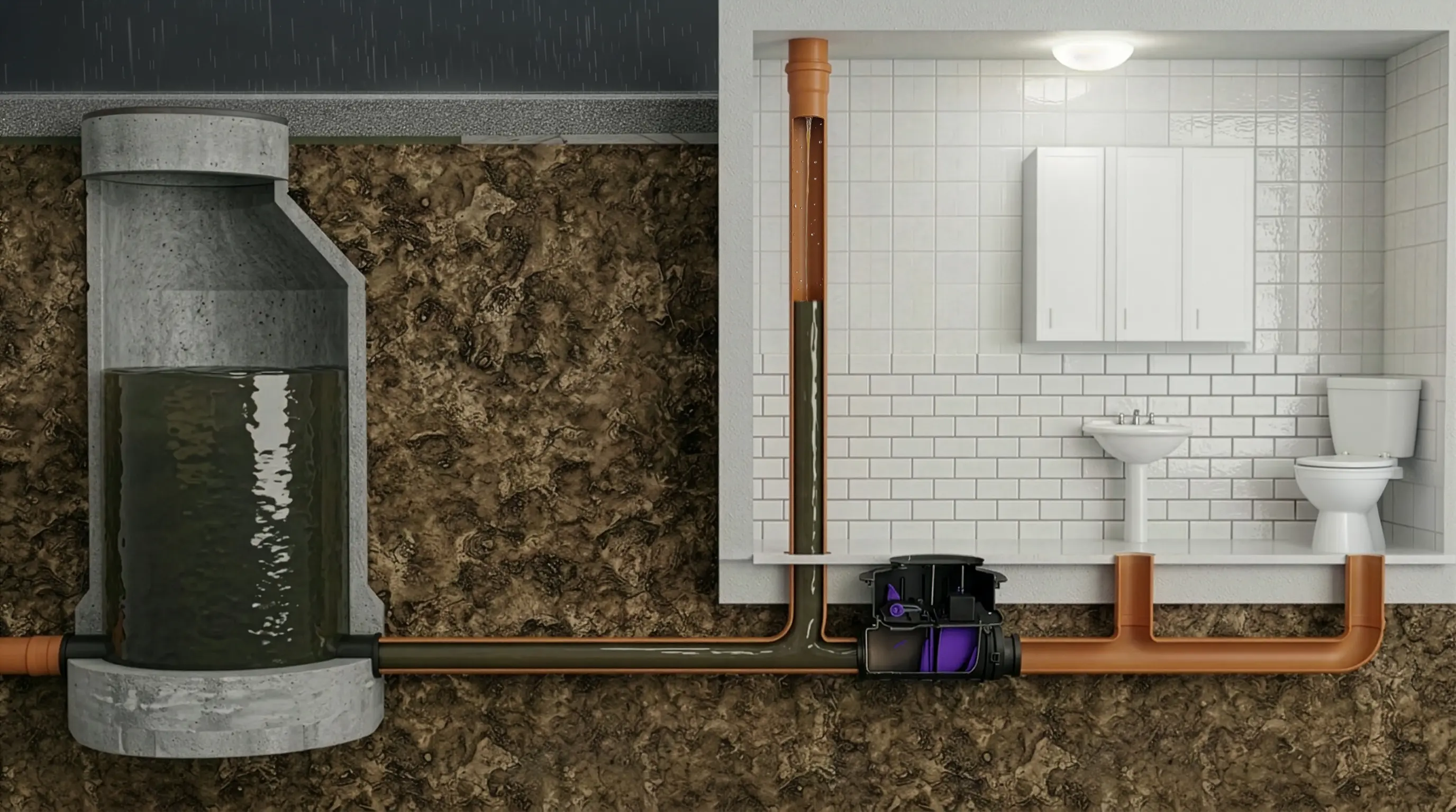
In this article, we take a closer look at a key component for protecting your home from water coming back out of the sewer: the backwater valve. You will learn how it works, how to retrofit a backwater valve in your drainage system and why reliable protection requires comprehensive backflow protection.
The correct technical term: In German-speaking countries, the everyday term for this component is “Rückstauklappe” (backflow flap), while the technically correct term is “Rückstauverschluss” (anti-flooding device or backwater valve). Strictly speaking, the flap is only one mechanical part of the complete device. For better readability, we use the familiar term “backwater valve” in this article, but we always mean the complete, professional and standard-compliant anti-flooding device.
Backwater valves at a glance
- Protective function: A backwater valve is designed to prevent wastewater from flowing back into the building’s drain and out of drains below the backflow level when (public) sewer networks are overloaded, e.g. by heavy rain, flooding or blockages.
- Easy to retrofit: In most properties, a backwater valve can be retrofitted without major construction work.
- Comprehensive protection: A backwater valve is only ever part of the solution. Reliable protection is only achieved with a well-thought-out backflow protection concept and its proper implementation.
- Models: Mechanical valves are used for wastewater without fecal matter (gray water). If toilets are connected to the pipe, an electric motorized backwater valve is required by law.
- Manufacturers & installation: Models from established brands (such as Kessel, HL or ACO) must always be installed by specialist companies (such as DerKanal), usually in the inspection chamber or directly in the basement.
- Maintenance: Without regular maintenance, the backwater valve and the backflow protection as a whole cannot be guaranteed to work. In the event of damage, this can even mean that your insurance cover lapses.
When does a backwater valve make sense?
The most important point first: A single backwater valve is never enough on its own to provide reliable protection against flooding – this always requires a comprehensive backflow protection concept.
Backwater valves must not be used in apartment buildings and may only be installed on drain pipes of minor use!
As mentioned above, the building blocks of such a concept include sealing measures and pumping stations in addition to backwater valves.
In principle, current standards assume that drainage systems are built to be protected against backflow, at least in new buildings. Some building insurance policies also make proper backflow protection a mandatory requirement.
In the vast majority of cases, the backflow level corresponds to the level of the street or sidewalk directly in front of your house.
Typical examples where action is needed:
- Basement rooms: Open floor drains in the boiler room, laundry room or storage room.
- Living space in the basement: Washbasins, showers or toilets that are below street level.
- Utility areas: Lower-lying connections for the washing machine or a utility sink in the basement.
The issue becomes particularly urgent if your property is connected to a combined sewer system. Here, rainwater and wastewater flow through the same pipe. When heavy downpours overload the public sewer, this mixture inevitably pushes back into unprotected house connections.
Retrofitting a backwater valve
Many homeowners ask themselves: can a backwater valve be retrofitted in an existing house? The clear answer is yes, in most cases this is easily possible.
There are two common installation locations for a backwater valve:
- In the inspection chamber: If there is a connection chamber (sewer manhole) on your property in front of the house, the valve can often be installed directly there.
- In an exposed basement pipe: Alternatively, the backwater valve can be integrated directly into the existing collecting pipe in the basement.
Important: think of backflow protection as a whole
A backwater valve is only part of the solution. For good protection, your drainage system must be considered as a whole. As part of our certified backflow protection, DerKanal creates an individual overall concept for you that protects you from water coming back out of the sewer.
Why a backwater valve alone is not enough
Many homeowners install a backwater valve and then feel safe – but that sense of security is deceptive. The backwater valve is only one link in the chain. Why? There are two main reasons:
- Leaking pipes: When the sewer is full during heavy rain, enormous water pressure builds up. If your valve is closed, the water backs up directly in front of it. If the pipes on your property have fine cracks or leaking joints, the water does not come up through the drain but escapes through the damaged pipe into the surrounding soil and floods the basement from the outside.
- “Self-flooding”: When the backwater valve is closed, not only is water prevented from coming in from outside – your own wastewater can no longer get out either! Anyone who takes a shower or flushes the toilet at that moment floods their own basement with their own wastewater.
That is why technology alone is not enough. Real protection against water damage only works as a system. This includes leak testing of the pipes and intelligent planning of the drainage. Find out more about our comprehensive backflow protection and how we protect your home in every respect.
Backflow protection in 5 steps
Many homeowners shy away from installing a backwater valve because they fear a major construction site. But don’t worry: with the right planning, retrofitting is usually done quickly and cleanly. This is what the path to certified backflow protection looks like at DerKanal:
1. Free initial consultation
In an initial, no-obligation consultation, we clarify your basic situation: have there already been problems with backflow? Which areas of your house are below street level? We already give you an initial assessment at this stage. For a first self-assessment beforehand, we recommend taking a look at our backflow checklist.
2. On-site analysis
Our experts examine your drainage system with state-of-the-art CCTV sewer inspection technology to determine the exact route of your pipes and find hidden weak points. This precise camera inspection is an essential basis for carefully planned and effective backflow protection. The cost of a CCTV sewer inspection depends on the length, accessibility, diameter and complexity of the pipes to be inspected. As a rough, non-binding guide: an inspection of around 30 meters of pipe costs approximately €300 to €450.
3. Transparent quote
Based on the results of the CCTV sewer inspection, we know which protective measures (such as mechanical or electric backwater valves or pressure-tight cleaning openings) your property needs. Only with this clear picture can we then prepare a tailor-made and fair quote for the actual backflow protection.
4. Professional installation
As soon as you place the order, we get started. Our trained technicians install the backflow protection professionally. After installation, we carry out a function test and explain what you should look out for in everyday life.
5. Maintenance & service
To ensure that the backflow protection works in an emergency, regular maintenance (approximately once or twice a year) is required and often also stipulated by insurers. We will be happy to take care of these regular inspections and cleaning for you.
Maintaining a backwater valve
Like any technical and mechanical component, a backwater valve needs regular care. Wastewater contains grease, hair, soap residue and dirt. Over time, these are deposited on the seals and moving parts of the valve.
If the valve is not maintained, the deposits can harden. In the worst case, the valve will then no longer close tightly during heavy rain. In addition, insurers often require proof of regular maintenance in the event of a claim. Without it, you will be left to pay the costs yourself.
That is why you should have your system inspected and cleaned regularly by a specialist company (ideally once or twice a year). You can find out more about the causes of backflow and how to take the right precautions in our general article on backflow and sewer maintenance.
Advantages and disadvantages of a backwater valve
Advantages of a backwater valve
- Protection: In heavy rain or flooding, a backwater valve protects against water entering from the overloaded public sewer. (Provided, however, that the backwater valve has been planned and installed as part of comprehensive backflow protection.)
- Cost-effective: Installing a backwater valve costs a fraction of what it costs to repair a water-damaged property. Apart from the financial burden, the construction work and the circumstances surrounding major water damage are extremely unpleasant.
- Easy to retrofit: In most properties, a backwater valve can be retrofitted without major construction work. In new buildings, backflow protection should ideally be planned and implemented right from the start.
- Insurance cover: Many insurers require a standard-compliant backflow protection system before they will cover any costs in the event of damage.
Disadvantages of a backwater valve
- Maintenance effort: Without regular care, the seals become clogged and stick. Regular maintenance (once or twice a year) is essential.
- Risk of self-flooding: If the valve is closed during a storm, your own wastewater cannot drain away either. Anyone who takes a shower or does the laundry then floods their own home.
- Susceptibility to blockages: Coarse dirt and solids from the drain can interfere with the closing mechanism. As a result, the system no longer closes when backflow occurs.
- False sense of security: If a drainage point (e.g. a bathroom in the basement) is below the backflow level and has no natural gradient, a backwater valve is not enough – a sewage lifting station is required. Cleaning openings that are not sealed pressure-tight are also a major risk. Conclusion: Effective protection always requires a comprehensively planned backflow protection concept.
DerKanal: your partner for backflow protection & backwater valves
When it comes to protecting your home from water coming back out of the sewer, you should not make any compromises. With our certified backflow protection, we are considered pioneers and offer you the best possible protection against flooding from the sewer. We plan and install backwater valves as part of comprehensive backflow protection for customers in Vienna, Lower Austria and Burgenland – and, on request, also in Styria, Carinthia, Salzburg and Upper Austria.
Every building is different. So feel free to request a free initial consultation with us at any time. We will answer your questions and find the best solution for your property.
Frequently asked questions about backwater valves
What is a backwater valve and how does it work?
Put simply, a backwater valve works like a one-way street for your wastewater. In normal operation, the water flowing out of the house pushes open the flaps inside and drains freely into the public sewer. However, as soon as water backs up in the street sewer and tries to push back into your house in the opposite direction, these flaps close automatically due to the water pressure (or, in electric models, by means of a motor).
What is a mechanical backwater valve?
A mechanical backwater valve works purely physically and requires no electricity at all. When water from the overloaded sewer pushes back towards the house, this water pressure automatically closes the built-in flaps (usually two flaps one behind the other).
When is it used? Under building regulations, it may only be used for wastewater without fecal matter (gray water). It is therefore the right choice if only showers, bathtubs, washbasins or washing machines are connected to the pipe that needs protecting. Its advantage: it is cheaper to buy and relatively easy to maintain.
What is an electric backwater valve?
In the electric version (also known as a motorized backwater valve), technology takes control. An integrated sensor constantly monitors the pipe. If this sensor detects backflow, a powerful electric motor automatically closes the valve with enormous force. At the same time, a visual and acoustic signal (alarm) in the house warns of the backflow event.
When is it used? It is mandatory for wastewater containing fecal matter (black water). As soon as a toilet is connected to the pipe that needs protecting, an electric model must be installed. The motor is so powerful that it even cuts through solids or toilet paper when closing.
Myth: “A backwater valve on its own is all the protection you need against sewer water.”
Unfortunately not! This is a dangerous misconception that often costs homeowners a lot of money. A backwater valve is an excellent and important component, but it is not a miracle cure if it is considered in isolation. Retrofitting often goes wrong in ways that have serious consequences during heavy rain. Two factors are decisive if the system is really to protect you in an emergency:
- An overall concept is needed: If the valve is installed in the wrong place or the pipes on the property are leaking, the water will find another way into the basement. That is why at DerKanal we always rely on a comprehensive system that also takes into account risks such as “self-flooding” or leaking cleaning-opening covers.
- The maintenance obligation: A backwater valve sits permanently in wastewater, surrounded by dirt, grease and hair. Without consistent care, the mechanism gets clogged and the component fails exactly when it matters.
Conclusion: Only the combination of professional planning (comprehensive backflow protection) and regular maintenance guarantees you a permanently dry basement and full insurance cover in the event of damage.
How much does a backwater valve cost?
The exact cost of a backwater valve including installation cannot be reliably stated as a flat rate, as the conditions are different for every property. The final price depends on two key factors:
- The model: A simple mechanical valve for gray water is considerably cheaper to buy than a sensor-controlled, electric motorized backwater valve for toilet wastewater.
- The construction work: If the valve can be fitted relatively easily into an exposed pipe in the basement, the costs are lower. If, on the other hand, the floor has to be opened up or excavation work is needed to install it in an inspection chamber in front of the house, the effort increases accordingly.
Our tip: As part of our certified backflow protection, we offer you a free initial consultation. After a professional on-site analysis of your situation, you will receive a transparent quote from us that is tailored exactly to the needs of your building.
What is the difference between an anti-flooding device and a backflow flap?
In German, “Rückstauklappe” (backflow flap) is the more familiar everyday term, but the technically correct, standardized term for the component is “Rückstauverschluss” (anti-flooding device). The difference lies in the details:
- The anti-flooding device refers to the complete, safe and standard-compliant component (e.g. in accordance with EN 13564). It usually consists of several elements, such as two flaps one behind the other or a motorized system for wastewater containing fecal matter.
- The backflow flap (often in the form of a mechanical swing flap) is, strictly speaking, only a single moving part within this anti-flooding device.